−50 / +70
°C operational
45°
Ascent + descent
23 in
Narrowest config
Zero
Exposed axles
Electric
Low signature
5
Configurations
The Platform
One core. Every mission.
Most vehicles are built for a job. 1track is built to become the job.
The base unit is the only constant in a system where everything else changes. Trailers, sleds, sensor arrays, medical modules, cargo, energy packs — they swap. The core doesn't. That's not a feature list. It's an architecture, and it's the reason one procurement decision covers capabilities you haven't scoped yet.

Mobility
Built from the ground up, not adapted down.
Most all-terrain vehicles start as wheeled platforms and get modified until they cope. 1track started somewhere else — engineered around four objectives with nothing else allowed to interfere.
- No exposed axles, differentials, or drivetrain below the hull
- Extremely low ground pressure — snow, mud, sand, soft ground
- Superior obstacle crossing and side-slope stability
- Sharply reduced risk of immobilization
Electric Drive
It works without announcing itself.
Electric drive means heavy towing and payload without the noise, the exhaust plume, or the heat bloom.
The low thermal signature is engineered, not incidental. A fully encapsulated structure minimizes direct heat radiation, and the track itself acts as a ventilation system — continuously drawing ambient air from ground level through the machine.
For defence, that reads as survivability. For commercial operators, it reads as night work and noise-restricted sites.
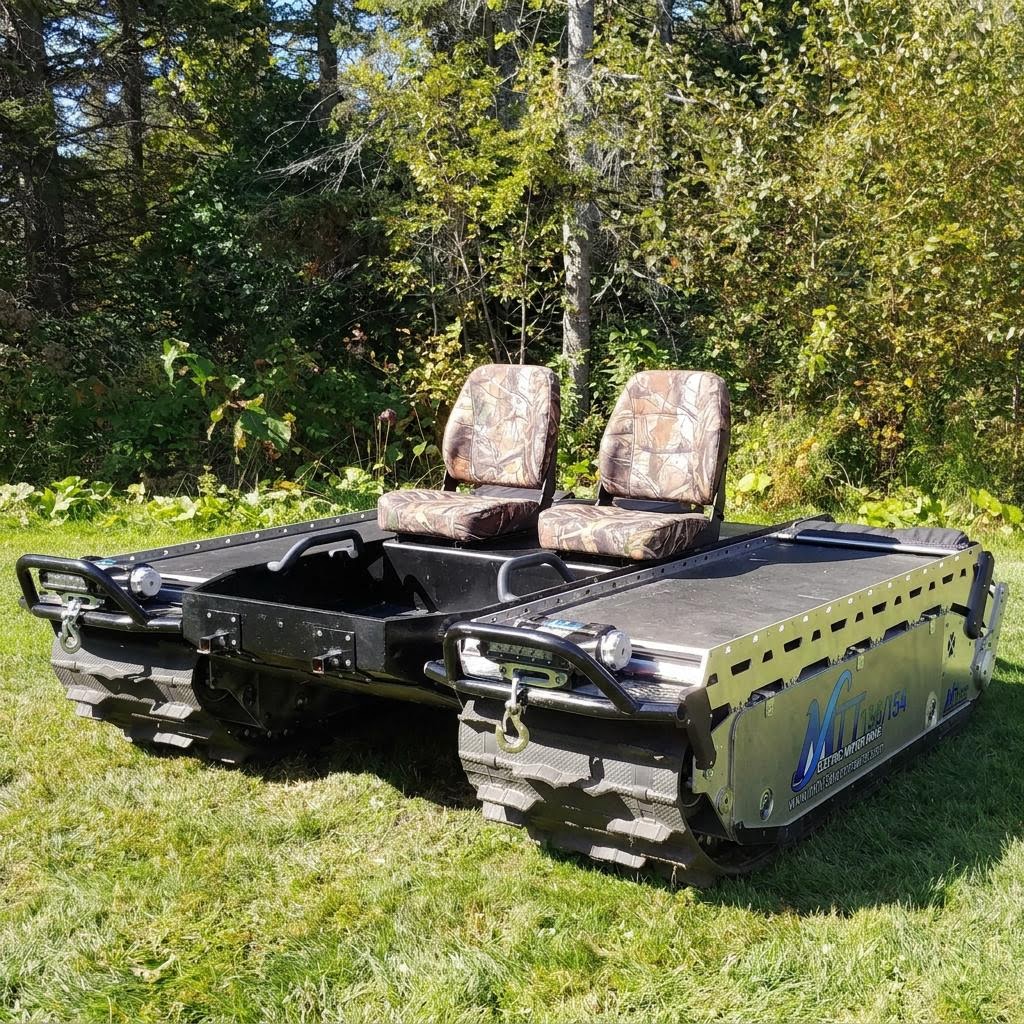
No seasonal conversion. No track kits. No downtime.
Wheeled systems need conversion kits when the ground turns. 1track doesn't have a summer configuration and a winter configuration. It has a configuration. Swamp, deep snow, sand, desert, Arctic — same machine, same setup, same day.
Field Proven
Validated where the stakes are highest.
1track earns its claims in the field. It runs daily in Antarctic research operations. It's in evaluation and service with defence organizations in Canada and the United States, tested against the terrain and temperature extremes that define the outer edge of what eUGV platforms are asked to do.